
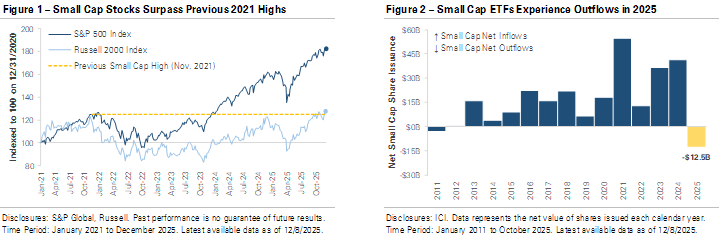
The S&P 500 has delivered strong returns the past two years, setting 57 all-time highs in 2024 and adding more than 35 in 2025. Large-cap stocks have benefited from a combination of AI enthusiasm, resilient earnings, and strong economic growth. However, one corner of the market has been noticeably absent: small-cap stocks. While the S&P 500 climbed to new highs, Figure 1 shows the Russell 2000, an index of small-cap stocks, remained stuck below its November 2021 peak. The four-year drought ended this fall when small caps broke through to new highs, driven by expectations for additional Federal Reserve rate cuts.
Small-cap stocks are more sensitive to interest rates than their large-cap counterparts. Many smaller companies carry higher debt loads relative to their size and rely more heavily on borrowing to fund growth. When interest rates rise, financing costs squeeze profit margins. Conversely, when interest rates fall, the pressure eases as borrowing becomes cheaper. Small’s recent underperformance began when the Federal Reserve started its rate-hiking cycle in 2022, but it started to reverse this year in Q3. Expectations for additional rate cuts have breathed new life into small caps. Small-cap stocks gained +12% in Q3 compared to +7.8% for large caps, the largest relative outperformance since Q1 2021. The outperformance has continued into Q4, with small caps outperforming large caps by +1.0% quarter-to-date.
Beyond the Fed's actions, valuations and investor flows tell a compelling story. Small-cap stocks trade at a significant discount to large caps, with the valuation gap at extremes. Figure 2 shows small-cap ETFs have posted net outflows this year, shedding roughly $12.5 billion through October 2025. It’s the first year of net outflows since 2011. The message is clear: small-cap stocks haven't just underperformed; they've been actively avoided. Investors poured money into large-cap tech and AI-related names while small caps were left behind. The combination of depressed valuations and persistent outflows suggests these stocks are not just undervalued but genuinely unloved and under owned. This creates a potential opportunity for long-term investors.
What does this mean for your portfolio? If you’ve benefited from the S&P 500's record run, the small-cap breakout raises a strategic question: Is it time to rebalance? The goal isn't to time the market but to evaluate whether your portfolio has drifted too far toward large caps and whether adding exposure to small caps aligns with your long-term goals. Small caps bring diversification at a time when the S&P 500 is highly concentrated in a few mega-cap tech names. Small caps are more domestically focused, spread across a wider range of industries, and less dependent on the AI narrative. While they are more volatile than large caps, the investment case appears to be strengthening. Fed rate cuts favor smaller borrowers, small caps trade at a steep valuation discount, and investor positioning is light. The recent breakout to new highs could mark a turning point. For those with a long-term horizon, small caps might deserve consideration in 2026.
Important Disclosures
Views expressed are as of the date indicated, based on the information available at that time, and may change based on market or other conditions. Investment decisions should be based on an individual’s own goals, time horizon, and tolerance for risk. Investing involves risk, including risk of loss. Investment advisory services provided by Provident Financial Planning, LLC, a SEC-Registered Investment Advisor.
The information and opinions provided herein are provided as general market commentary only and are subject to change at any time without notice. This commentary may contain forward-looking statements that are subject to various risks and uncertainties. None of the events or outcomes mentioned here may come to pass, and actual results may differ materially from those expressed or implied in these statements. No mention of a particular security, index, or other instrument in this report constitutes a recommendation to buy, sell, or hold that or any other security, nor does it constitute an opinion on the suitability of any security or index. The report is strictly an informational publication and has been prepared without regard to the particular investments and circumstances of the recipient.
Past performance does not guarantee or indicate future results. Any index performance mentioned is for illustrative purposes only and does not reflect any management fees, transaction costs, or expenses. Indexes are unmanaged, and one cannot invest directly in an index. Index performance does not represent the actual performance that would be achieved by investing in a fund.
Subscribe to receive the latest blog posts to your inbox every week.
Explore our expertly curated articles offering deeper knowledge and understanding on a range of financial topics.
Guided by our values of faith, service, and transparency, we at Provident Financial Planning are ready to help you navigate your financial journey. Schedule a consultation with us and discover how we can create a personalized financial plan for you.